Hildegard von Bingen
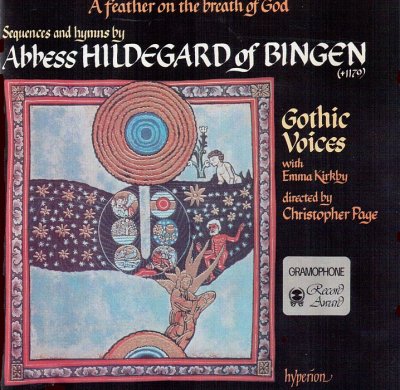
Saint Hildegard of Bingen (German: von Bingen, Latin: Bingensis) (September 16, 1098 - September 17, 1179) was a German magistra, monastic leader, mystic, author, and composer of music. Hildegard was born into a family of nobles in the service of the counts of Sponheim, close relatives of the Hohenstaufen emperors. Because she was a tenth child, and a sickly one from birth, and also perhaps as a political move, at the age of eight Hildegard's parents sent her as a tithe to the church. Hildegard was put in the care of Jutta, the sister of Count Meinhard of Sponheim, just outside the Disibodenberg monastery in Germany. Jutta was enormously popular and acquired so many followers a small nunnery sprang up around her. Upon Jutta's death in 1136 Hildegard was chosen magistra of the community, and eventually moved the group to a new monastery on the Rupertsberg at Bingen on the Rhine. From the time she was very young, Hildegard claimed to have visions. She received a prophetic call from God five years after her election as magistra in 1141 demanding of her, "Write what you see". At first she was hesitant about writing her visions, holding them inside. She was finally convinced to write by members of her order after falling physically ill from carrying the unspoken burden. Recent scholarly interest in women in the medieval church has led to a popularization of Hildegard - and particularly of her music. Approximately eighty compositions survive, which is a far larger repertoire than almost any other medieval composer. Among her better known works is the Ordo Virtutum ("Order of the Virtues" or "Play of the Virtues"), a type of early oratorio for women's voices, with one male part - that of the Devil. It was created, like all of Hildegard's music, to be performed by the nuns of her convent. The text of her compositions uses a form of modified medieval Latin unique to Hildegard, for which she created many invented, conflated and abridged words, while the music itself is monophonic, designed for limited instrumental accompaniment (usually just using hurdy gurdy drones), and characterised by soaring soprano vocalisations. In addition to music, Hildegard also wrote medical, botanical and geological treatises, and she even invented an alternative alphabet. Due to her inventions of words for her lyrics and a constructed script, many conlangers look upon her as a mediaeval precursor. She collected her visions into three books: the first and most important Scivias ("Know the Way") completed in 1151, Liber vitae meritorum ("Book of Life's Merits") and De operatione Dei ("Of God's Activities") also known as Liber divinorum operum ("Book of Divine Works"). In these volumes, written over the course of her life until her death in 1179, she first describes each vision, then interprets them. The narrative of her visions was richly decorated under her direction, presumably drawn by other nuns in the convent, while transcription assistance was provided by the monk Volmar (see illustration) with pictures of the visions. Her interpretations are usually quite traditionally Catholic in nature. Her vivid description of the physical sensations which accompanied her visions have been diagnosed by neurologists (including popular author Oliver Sacks) as symptoms of migraine; however others have seen in them merely colourful illustrations of the prevailing church doctrine of her time, which she supported, rather than actual visions. The book was celebrated in the Middle Ages and printed for the first time in Paris in 1513. Hildegard's visionary writings maintain that virginity is the highest level of the spiritual life. There are many instances both in her letters and visions which decry the misuse of carnal pleasures. In Scivias Book II Vision Six.78, "God united man and woman, thus joining the strong to the weak, that each might sustain the other. But these perverted adulterers change their virile strength into perverse weakness, rejecting the proper male and female roles, and in their wickedness they shamefully follow Satan, who in his pride sought to split and divide Him Who is indivisible. They create in themselves by their wicked deeds a strange and perverse adultery, and so appear polluted and shameful in My sight..." "...a woman who takes up devilish ways and plays a male role in coupling with another woman is most vile in My sight, and so is she who subjects herself to such a one in this evil deed..." "...And men who touch their own genital organ and emit their semen seriously imperil their souls, for they excite themselves to distraction; they appear to Me as impure animals devouring their own whelps, for they wickedly produce their semen only for abusive pollution..." "...When a person feels himself disturbed by bodily stimulation let him run to the refuge of continence, and seize the shield of chastity, and thus defend himself from uncleanness." (translation by Mother Columba Hart and Jane Bishop). Hildegard was a powerful woman by the standards of the Middle Ages. She communicated with Popes such as Eugene III and Anastasius IV, statesmen such as Abbot Suger, German emperors such as Frederick I Barbarossa, and on one occasion with St. Bernard of Clairvaux who although he reportedly advanced her work at the Synod of Trier 1147/48, seemed to have little regard for her as evidenced from the one letter from him she received. Nevertheless many Abbots and Abbesses asked her for prayers and opinions on various matters. She traveled widely, giving public speeches, a rarity for a woman of the time. Hildegard was one of the first saints for which the canonization process was officially applied, but the process took so long that all four attempts at canonization (the last was in 1244, under Pope Innocent IV) were not completed, and remained at her beatification. However, she was already called a saint by the people before the canonization attempts. As a result of the long-standing devotion of the people to Hildegard, her name was taken up in the Roman martyrology at the end of the 16th century without a formal canonization process, earning her the title of saint. Her feast day is September 17. The shrine with the relics of Hildegard is in her second monastery in Eibingen near Rüdesheim (on the Rhine).
Discography
Credits