Giovanni Pierluigi da Palestrina
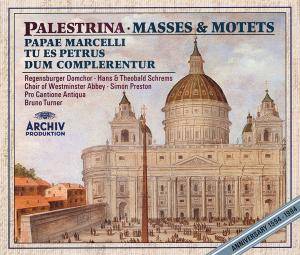
Giovanni Pierluigi da Palestrina (c. 1525 – 2 February 1594) was an Italian Renaissance composer of sacred music and the best-known 16th-century representative of the Roman School of musical composition. He has had a lasting influence on the development of church music, and his work has often been seen as the culmination of Renaissance polyphony. Palestrina was born in the town of Palestrina, near Rome, then part of the Papal States. Documents suggest that he first visited Rome in 1537, when he is listed as a chorister at the Santa Maria Maggiore basilica. He studied with Robin Mallapert and Firmin Lebel. He spent most of his career in the city. Palestrina came of age as a musician under the influence of the northern European style of polyphony, which owed its dominance in Italy primarily to two influential Netherlandish composers, Guillaume Dufay and Josquin des Prez, who had spent significant portions of their careers there. Italy itself had yet to produce anyone of comparable fame or skill in polyphony. From 1544 to 1551, Palestrina was organist of the principal church (St. Agapito) of his native city. His first published compositions, a book of Masses, had made so favorable an impression with Pope Julius III (previously the Bishop of Palestrina) that in 1551 he appointed Palestrina maestro di cappella or musical director of the Cappella Giulia, (Julian Chapel, in the sense of choir), the choir of the chapter of canons at St Peter's. This book of Masses was the first by a native composer, since in the Italian states of Palestrina's day, most composers of sacred music were from the Low Countries, France, Portugal, or Spain. In fact the book was modeled on one by Cristóbal de Morales: the woodcut in the front is almost an exact copy of the one from the book by the Spanish composer. During the next decade, Palestrina held positions similar to his Julian Chapel appointment at other chapels and churches in Rome, notably St John Lateran, (1555–1560 – a post previously held by Lassus) and St Mary Major (1561–1566). In 1571 he returned to the Julian Chapel and remained at St Peter's for the rest of his life. The decade of the 1570s was difficult for him personally: he lost his brother, two of his sons, and his wife in three separate outbreaks of the plague (1572, 1575, and 1580, respectively). He seems to have considered becoming a priest at this time, but instead he remarried, this time to a wealthy widow. This finally gave him financial independence (he was not well paid as choirmaster) and he was able to compose prolifically until his death. He died in Rome of pleurisy in 1594. As was usual, Palestrina was buried on the same day he died, in a plain coffin with a lead plate on which was inscribed Libera me Domine. A five-part psalm for three choirs was sung at the funeral. Music and reputation See also: List of compositions by Giovanni Pierluigi da Palestrina and Counterpoint Palestrina left hundreds of compositions, including 105 masses, 68 offertories, at least 140 madrigals and more than 300 motets. In addition, there are at least 72 hymns, 35 magnificats, 11 litanies, and four or five sets of lamentations. His attitude toward madrigals was somewhat enigmatic: whereas in the preface to his collection of Canticum canticorum (Song of Songs) motets (1584) he renounced the setting of profane texts, only two years later he was back in print with Book II of his secular madrigals (some of these being among the finest compositions in the medium). He published just two collections of madrigals with profane texts, one in 1555 and another in 1586. The other two collections were spiritual madrigals, a genre beloved by the proponents of the Counter-Reformation. Palestrina's masses show how his compositional style developed over time.His Missa sine nomine seems to have been particularly attractive to Johann Sebastian Bach, who studied and performed it while writing the Mass in B minor. Most of Palestrina's masses appeared in thirteen volumes printed between 1554 and 1601, the last seven published after his death. One of his most important works, the Missa Papae Marcelli (Pope Marcellus Mass), has been historically associated with erroneous information involving the Council of Trent. According to this tale (which forms the basis of Hans Pfitzner's opera Palestrina), it was composed in order to persuade the Council of Trent that a draconian ban on the polyphonic treatment of text in sacred music (as opposed, that is, to a more directly intelligible homophonic treatment) was unnecessary. However, more recent scholarship shows that this mass was in fact composed before the cardinals convened to discuss the ban (possibly as much as ten years before). Historical data indicates that the Council of Trent, as an official body, actually never banned any church music and failed to make any ruling or official statement on the subject. These stories originated from the unofficial points-of-view of some Council attendees who discussed their ideas with those not privy to the Council's deliberations. Those opinions and rumors have, over centuries, been transmuted into fictional accounts, put into print, and often incorrectly taught as historical fact. While Palestrina's compositional motivations are not known, he may have been quite conscious of the need for intelligible text; however, this was not to conform with any doctrine of the Counter-Reformation, because no such doctrine exists. His characteristic style remained consistent from the 1560s until the end of his life. Roche's hypothesis that Palestrina's seemingly dispassionate approach to expressive or emotive texts could have resulted from his having to produce many to order, or from a deliberate decision that any intensity of expression was unbecoming in church music, has not been confirmed by historians. One of the hallmarks of Palestrina's music is that dissonances are typically relegated to the "weak" beats in a measure. This produced a smoother and more consonant type of polyphony which is now considered to be definitive of late Renaissance music, given Palestrina's position as Europe's leading composer (along with Lassus) in the wake of Josquin (d. 1521). The "Palestrina style" now serves as a basis for college Renaissance counterpoint classes, thanks in large part to the efforts of the 18th-century composer and theorist Johann Joseph Fux, who, in a book called Gradus ad Parnassum (Steps to Parnassus, 1725), set about codifying Palestrina's techniques as a pedagogical tool for students of composition. Fux applied the term "species counterpoint", which entails a series of steps whereby students work out progressively more elaborate combinations of voices while adhering to certain strict rules. Fux did make a number of stylistic errors, however, which have been corrected by later authors (notably Knud Jeppesen and Morris). Palestrina's own music contains ample instances in which his rules have been followed to the letter, as well as many where they are freely broken. According to Fux, Palestrina had established and followed these basic guidelines: The flow of music is dynamic, not rigid or static. Melody should contain few leaps between notes. (Jeppesen: "The line is the starting point of Palestrina's style.") If a leap occurs, it must be small and immediately countered by stepwise motion in the opposite direction. Dissonances are to be confined to passing notes and weak beats. If one falls on a strong beat, it is to be immediately resolved. Much research on Palestrina was done in the 19th century by Giuseppe Baini, who published a monograph in 1828 which made Palestrina famous again and reinforced the already existing legend that he was the "Saviour of Church Music" during the reforms of the Council of Trent. The 19th century proclivity for hero-worship is predominant in this monograph, however, and this has remained with the composer to some degree to the present day. Hans Pfitzner's opera Palestrina shows this attitude at its peak. It is only recently, with the discovery and publication of a great deal of hitherto unknown or forgotten music by various Renaissance composers, that it has been possible to properly assess Palestrina in a historical context. Though Palestrina represents late Renaissance music well, others such as Orlande de Lassus (a Franco-Flemish composer who also spent some of his early career in Italy) and William Byrd were arguably more versatile. 20th and 21st century scholarship by and large retains the view that Palestrina was a strong and refined composer whose music represents a summit of technical perfection, while emphasizing that some of his contemporaries possessed equally individual voices even within the confines of "smooth polyphony." As a result, composers like Lassus and Byrd as well as Tomas Luis de Victoria have increasingly come to enjoy comparable reputations. Palestrina was famous in his day, and if anything his reputation increased after his death. Conservative music of the Roman school continued to be written in his style (which in the 17th century came to be known as the prima pratica) by such students of his as Giovanni Maria Nanino, Ruggiero Giovanelli, Arcangelo Crivelli, Teofilo Gargari, Francesco Soriano and Gregorio Allegri. It is also thought that Salvatore Sacco may have been a student of Palestrina, as well as Giovanni Dragoni, who later went on to become choirmaster in the church of S. Giovanni in Laterano. Palestrina's music continues to be regularly performed and recorded, and to provide models for the study of counterpoint. There are two comprehensive editions of Palestrina's works: a 33-volume edition published by Breitkopf and Härtel, in Leipzig Germany between 1862 and 1894 edited by Franz Xaver Haberl, and a 34-volume edition published in the mid twentieth century, by Fratelli Scalera, in Rome, Italy edited by R. Casimiri and others.
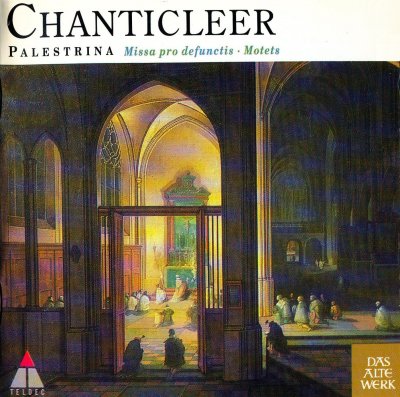
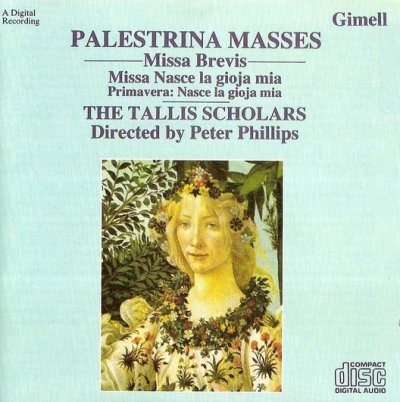
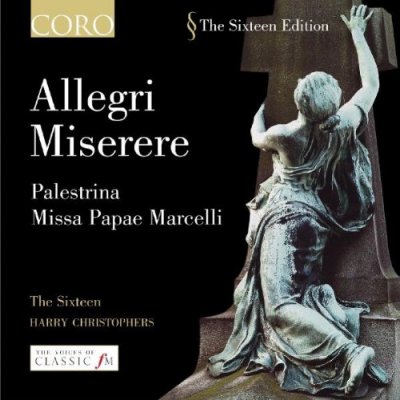
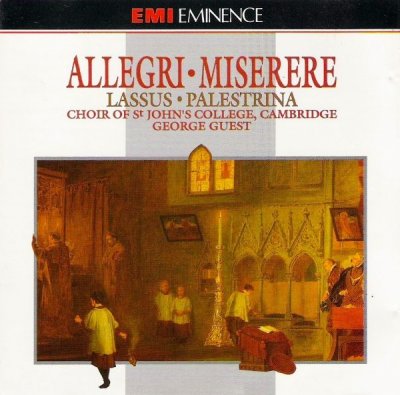
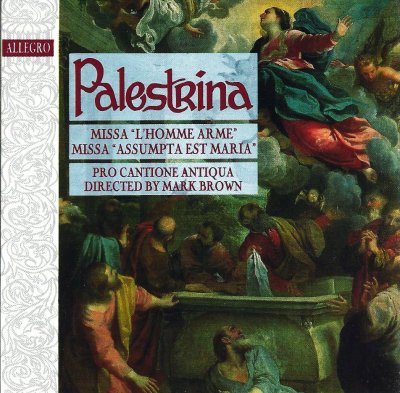
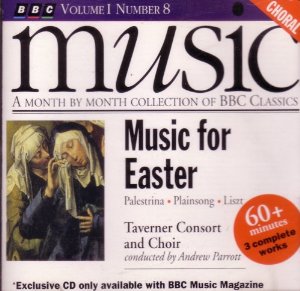
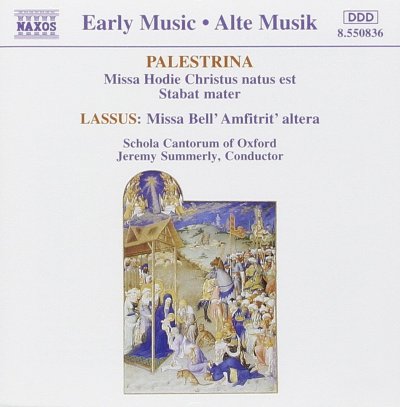
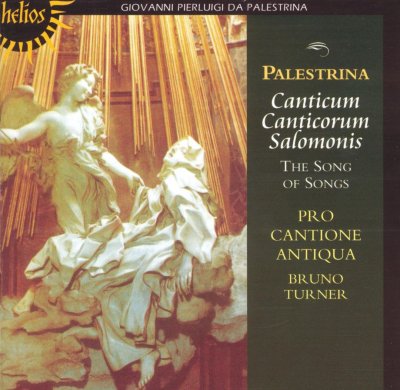
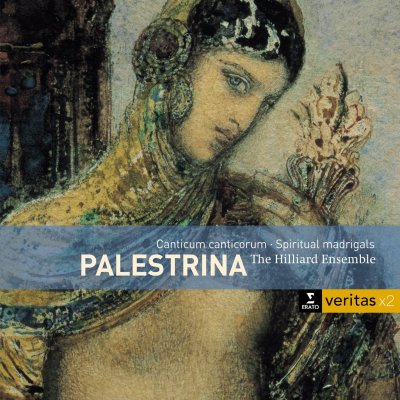
Discography
Credits