George Butterworth
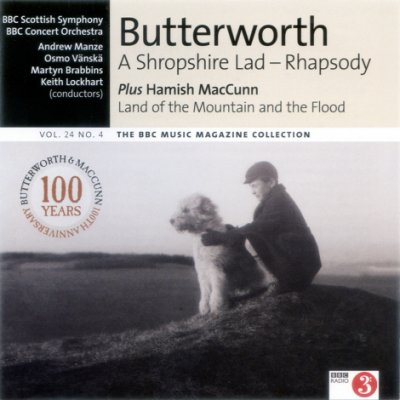
George Sainton Kaye Butterworth, MC (12 July 1885 – 5 August 1916) was an English composer who was best known for the orchestral idyll The Banks of Green Willow and his song settings of A. E. Housman's poems from A Shropshire Lad.
Early years
Blue plaque commemorating Butterworth's childhood home in Driffield Terrace, York Butterworth was born in Paddington, London. Soon after his birth, his family moved to York so that his father Sir Alexander Kaye Butterworth could take up an appointment as general manager of the North Eastern Railway, which was based there. Their home was at Riseholme, a house on Driffield Terrace, which later became part of the Mount School. In 2016, the centenary year of his death on the Somme, biographer Anthony Murphy unveiled on behalf of the York Civic Trust a blue plaque to his memory at College House, Driffield Terrace, part of the Mount School.
George received his first music lessons from his mother, who was a singer, and he began composing at an early age. As a young boy, he played the organ for services in the chapel of his preparatory school, Aysgarth School, before gaining a scholarship to Eton College. He showed early musical promise at Eton, a "Barcarolle" for orchestra being played during his time there (it is long since lost).
Butterworth then went up to Trinity College, Oxford, where he became more focused on music, becoming President of the University Music Club. He also made friends with the folk song collector Cecil Sharp; the composer and folk song enthusiast Ralph Vaughan Williams; the future Director of the Royal College of Music, Hugh Allen; and a baritone and future conductor, Adrian Boult. Butterworth and Vaughan Williams made several trips into the English countryside to collect folk songs (Butterworth collected over 450 himself, many in Sussex in 1907, and sometimes using a phonograph) and the compositions of both were strongly influenced by what they collected. Butterworth was also an expert folk dancer, being particularly keen in the art of morris dancing. He was employed for a while by the English Folk Dance and Song Society (of which he was a founder member in 1906) as a professional morris dancer, and was a member of the Demonstration Team.
Upon leaving Oxford, Butterworth began a career in music, writing criticism for The Times, composing, and teaching at Radley College, Oxfordshire. He also briefly studied piano and organ at the Royal College of Music, where he worked with Hubert Parry among others, though he stayed less than a year as the academic life was not for him.
Vaughan Williams and Butterworth became close friends. It was Butterworth who suggested to Vaughan Williams that he turn a symphonic poem he was working on into his London Symphony. Vaughan Williams recalled:
We were talking together one day when he said in his gruff, abrupt manner: ‘You know, you ought to write a symphony’. I answered...that I’d never written a symphony and never intended to...I suppose Butterworth’s words stung me and, anyhow, I looked out some sketches I had made for...a symphonic poem about London and decided to throw it into symphonic form...From that moment, the idea of a symphony dominated my mind. I showed the sketches to George bit by bit as they were finished, and it was then that I realised that he possessed in common with very few composers a wonderful power of criticism of other men’s work and insight into their ideas and motives. I can never feel too grateful to him for all he did for me over this work and his help did not stop short at criticism.
When the manuscript for that piece was lost (having been sent to Germany, either to the conductor Fritz Busch or for engraving, just before the outbreak of war), Butterworth, together with Geoffrey Toye and the critic Edward J. Dent, helped Vaughan Williams reconstruct the work. Vaughan Williams dedicated the piece to Butterworth's memory after his death.
Discography