Edvard Grieg
Edvard Hagerup Grieg was a Norwegian composer and pianist. He is widely considered one of the leading Romantic era composers, and his music is part of the standard classical repertoire worldwide. His use and development of Norwegian folk music in his own compositions put the music of Norway in the international spectrum, as well as helping develop a national identity, much like Jean Sibelius and Antonín Dvořák did in Finland and Bohemia respectively. Edvard Hagerup Grieg was born in Bergen, Norway, on 15 June 1843. His parents were Alexander Grieg (1806–1875), a merchant and vice consul in Bergen; and Gesine Judithe Hagerup (1814–1875), a music teacher and daughter of Edvard Hagerup. The family name, originally spelled Greig, has Scottish origins. After the Battle of Culloden in 1746, Grieg's great-grandfather, Alexander Greig, traveled widely, settling in Norway about 1770, and establishing business interests in Bergen.
Edvard Grieg was raised in a musical milieu. His mother was his first piano teacher and taught him to play at the age of six. Grieg studied in several schools, including Tanks Upper School, Tanks School and the N.P.S, Norwegian Private School. In the summer of 1858, Grieg met the eminent Norwegian violinist Ole Bull, who was a family friend; Bull's brother was married to Grieg's aunt. Bull recognized the 15-year-old boy's talent and persuaded his parents to send him to the Leipzig Conservatory, then directed by Ignaz Moscheles. Grieg enrolled in the conservatory, concentrating on the piano, and enjoyed the many concerts and recitals given in Leipzig. He disliked the discipline of the conservatory course of study. An exception was the organ, which was mandatory for piano students. In the spring of 1860, he survived a life-threatening lung disease, pleurisy and tuberculosis. Throughout his life, Grieg's health was impaired by a destroyed left lung and considerable deformity of his thoracic spine. He suffered from numerous respiratory infections, and ultimately developed combined lung and heart failure. Grieg was admitted many times to spas and sanatoria both in Norway and abroad. Several of his doctors became his personal friends. In 1861, Grieg made his debut as a concert pianist in Karlshamn, Sweden. In 1862, he finished his studies in Leipzig and held his first concert in his home town, where his programme included Beethoven's Pathétique sonata.
In 1863, Grieg went to Copenhagen, Denmark, and stayed there for three years. He met the Danish composers J. P. E. Hartmann and Niels Gade. He also met his fellow Norwegian composer Rikard Nordraak (composer of the Norwegian national anthem), who became a good friend and source of inspiration. Nordraak died in 1866, and Grieg composed a funeral march in his honor.
On 11 June 1867, Grieg married his first cousin, Nina Hagerup. The next year, their only child, Alexandra, was born. Alexandra died in 1869 from meningitis. In the summer of 1868, Grieg wrote his Piano Concerto in A minor while on holiday in Denmark. Edmund Neupert gave the concerto its premiere performance on 3 April 1869 in the Casino Theater in Copenhagen. Grieg himself was unable to be there due to conducting commitments in Christiania (as Oslo was then named). In 1868, Franz Liszt, who had not yet met Grieg, wrote a testimonial for him to the Norwegian Ministry of Education, which led to Grieg's obtaining a travel grant. The two men met in Rome in 1870. On Grieg's first visit, they went over Grieg's Violin Sonata No. 1, which pleased Liszt greatly. On his second visit, in April, Grieg brought with him the manuscript of his Piano Concerto, which Liszt proceeded to sightread (including the orchestral arrangement). Liszt's rendition greatly impressed his audience, although Grieg gently pointed out to him that he played the first movement too quickly. Liszt also gave Grieg some advice on orchestration, (for example, to give the melody of the second theme in the first movement to a solo trumpet).
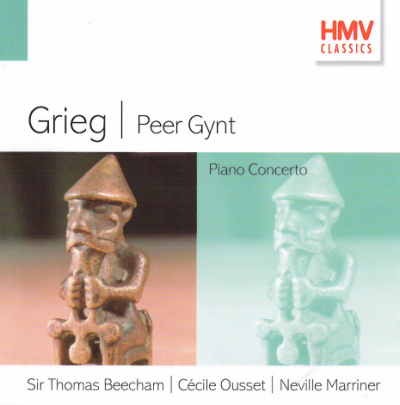
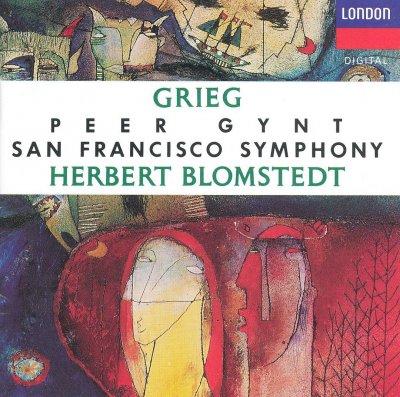
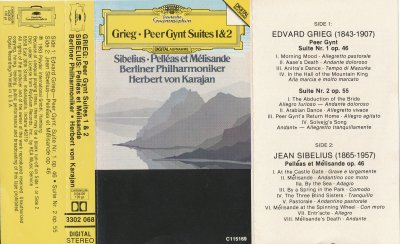
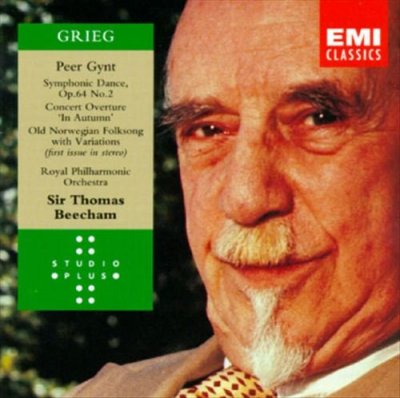
In 1874–76, Grieg composed incidental music for the premiere of Henrik Ibsen's play Peer Gynt, at the request of the author.
Grieg had close ties with the Bergen Philharmonic Orchestra (Harmonien), and later became Music Director of the orchestra from 1880–1882. In 1888, Grieg met Tchaikovsky in Leipzig. Grieg was struck by the sadness in Tchaikovsky. Tchaikovsky thought very highly of Grieg's music, praising its beauty, originality and warmth. The Norwegian government awarded him a pension. In the spring 1903, Grieg made nine 78-rpm gramophone recordings of his piano music in Paris; all of these historic discs have been reissued on both LPs and CDs, despite limited fidelity. Grieg also made live-recording player piano music rolls for the Hupfeld Phonola piano-player system and Welte-Mignon reproducing system, all of which survive today and can be heard. He also worked with the Aeolian Company for its 'Autograph Metrostyle' piano roll series wherein he indicated the tempo mapping for many of his pieces.
In 1906, he met the composer and pianist Percy Grainger in London. Grainger was a great admirer of Grieg's music and a strong empathy was quickly established. In a 1907 interview, Grieg stated: “I have written Norwegian Peasant Dances that no one in my country can play, and here comes this Australian who plays them as they ought to be played! He is a genius that we Scandinavians cannot do other than love.” Edvard Grieg died in the late summer of 1907, aged 64, after a long period of illness. His final words were "Well, if it must be so." The funeral drew between 30,000 and 40,000 people out on the streets of his home town to honor him. Following his wish, his own Funeral March in Memory of Rikard Nordraak was played in an orchestration by his friend Johan Halvorsen, who had married Grieg's niece. In addition, the Funeral March movement from Chopin's Piano Sonata No. 2 was played. Grieg was cremated, and his ashes were entombed in a mountain crypt near his house, Troldhaugen. The ashes of his wife were later placed with his. Some of Grieg's early works include a symphony (which he later suppressed) and a piano sonata. He also wrote three violin sonatas and a cello sonata.Grieg also composed "Peer Gynt Suite - In the Hall of the Mountain King". It was used as incidental music for the play "Peer Gynt". In this piece of music, Peer steals the bride at a wedding. The angry guests chase him, and Peer falls, hitting his head on a rock. He wakes up in a mountain surrounded by trolls. The music represents the angry trolls taunting Peer and gets louder each time the theme repeats. The music ends with Peer escaping from the mountain.
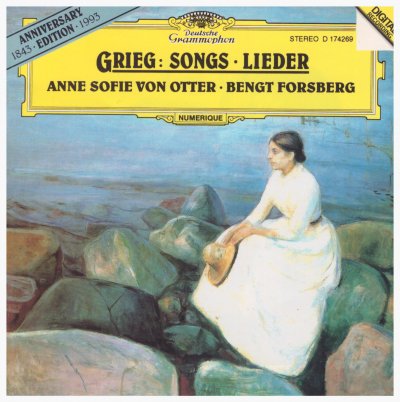
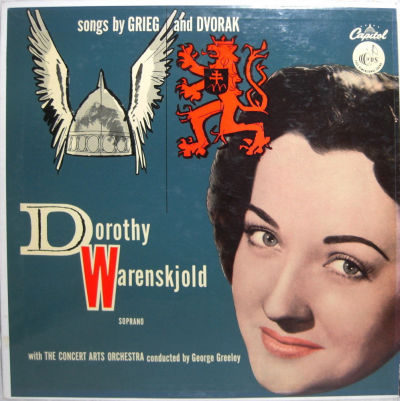
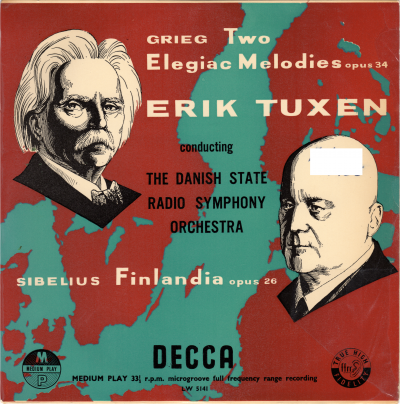
In a 1874 letter to his friend Frants Beyer, Grieg expressed his unhappiness with In the Hall of the Mountain King, one of his compositions from Peer Gynt, writing "I have also written something for the scene in the hall of the mountain King – something that I literally can't bear listening to because it absolutely reeks of cow-pies, exaggerated Norwegian nationalism, and trollish self-satisfaction! But I have a hunch that the irony will be discernible." Grieg's Holberg Suite was originally written for the piano, and later arranged by the composer for string orchestra. Grieg wrote songs in which he set lyrics by poets Heinrich Heine, Johann Wolfgang von Goethe, Henrik Ibsen, Hans Christian Andersen, Rudyard Kipling and others. Russian composer Nikolai Myaskovsky used a theme by Grieg for the variations with which he closed his Third String Quartet. Norwegian pianist Eva Knardahl recorded the composer's complete piano music during 1978 and 1980. The recordings were reissued in 2006 on 12 compact discs by BIS Records.
Discography
Credits