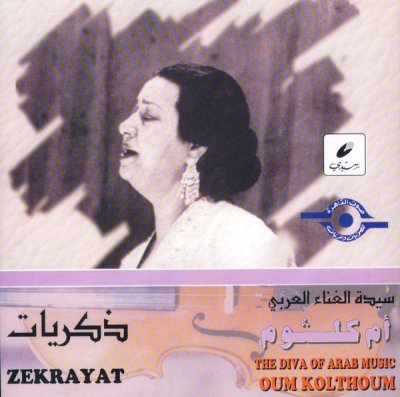
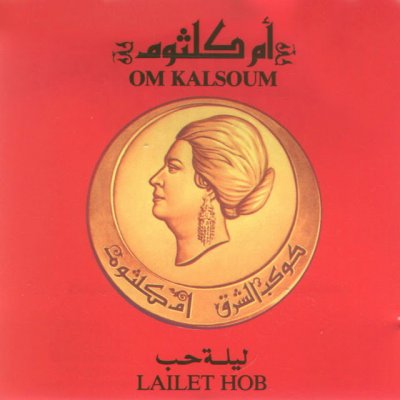
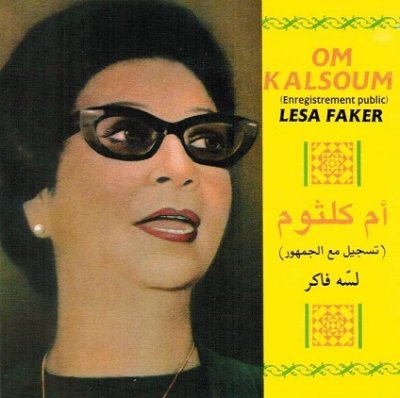
Umm Kulthum (Arabic: أم كلثوم ʾUmm Kulṯūm; other English spellings include: Umm Kulthum, Om Kalthoum, Oum Kalsoum, Oum Kalthum, Omm Kolsoum, Umm Kolthoum, Um Kalthoom) born Fātimah ʾIbrāhīm as-Sayyid al-Biltāǧī was an internationally famous Egyptian singer, songwriter, and film actress of the 1930s to the 1970s. She is known as Kawkab al-Sharq كوكب الشرق ("Star of the East") in Arabic.
Umm Kulthum was born in the village of Tamay e-Zahayra, belonging to the city of El Senbellawein, Dakahlia Governorate, in the Nile Delta. Her birth date is unconfirmed At a young age she showed exceptional singing talent. Her father, an imam at the local mosque, taught her to recite the Qur'an, and she is said to have memorized the entire book. When she was 12 years old, her father disguised her as a young boy and entered her in a small performing troupe that he directed. At the age of 16, she was noticed by Mohamed Aboul Ela, a modestly famous singer, who taught her the old classical Arab repertoire. A few years later, she met the famous composer and oudist Zakariyya Ahmad, who invited her to come to Cairo. Although she made several visits to Cairo in the early 1920s, she waited until 1923 before permanently moving there.
Amin Al Mahdi introduced her to the cultural circles in Cairo, where she carefully avoided succumbing to the attractions of the bohemian lifestyle and, indeed, throughout her life, stressed her pride in her humble origins and espousal of conservative values. She also maintained a tightly managed public image, which undoubtedly added to her allure.
At this point in her career, Umm Kulthum was introduced to the famous poet Ahmad Rami, who wrote 137 songs for her. Rami also introduced her to French literature, which he greatly admired from his studies at the Sorbonne, Paris, and eventually became her head mentor in Arabic literature and literary analysis. Furthermore, she was introduced to the renowned oud virtuoso and composer Mohamed El Qasabgi, who introduced her to the Arabic Theatre Palace, where she would experience her first real public success. In 1932, her fame as a singer increased through sales of her records to the point where she embarked upon a major tour of the Middle East, performing in important Arab cities such as Damascus, Syria; Baghdad, Iraq; Beirut, Lebanon; and Tripoli, Libya.
By 1948 her fame had come to the attention of Gamal Abdel Nasser, who would later become the president of Egypt. At one point the Egyptian musicians guild of which she became a member (and eventually president) rejected her because she had sung for the then-deposed king, Farouk of Egypt. It was his favour that made the musicians’ guild accept her back into the fold. In addition, Kalthoum had been a dedicated Egyptian patriot since the time of King Farouk.
Her songs deal mostly with the universal themes of love, longing and loss. A typical concert consisted of the performance of two or three songs over a period of three to six hours. In the late 1960s, due to her age, she began to shorten her performances to two songs over a period of two and a half to three hours. The duration of her songs in performance was not fixed, but varied based on the level of emotional interaction between the singer and her audience. A typical improvisatory technique of hers was to repeat a single phrase or sentence of a song’s lyrics over and over, subtly altering the emotive emphasis and intensity each time to bring her audiences into a euphoric and ecstatic state. Thus, while the official recorded length of a song such as “Enta omri” (You Are My Life) is approximately sixty minutes, a live performance could extend to many hours, as the singer and her audience fed off each other’s emotional energy. This intense, highly personalised creative relationship was undoubtedly one of the reasons for Kalthoum’s tremendous success as an artist.
In 1967 Kalthoum was diagnosed with a severe case of nephritis. She gave her last concert at the Palace of the Nile in 1973. Tests at that time indicated that her illness was incurable. She moved to the United States, where she benefited for some time from the advanced medical technology, but in 1975, upon re-entering her home country, she required hospitalisation due to declining health. She died in a Cairo hospital on 3rd February 1975.
Her funeral was attended by over four million mourners – one of the largest gatherings in history – and descended into pandemonium when the crowd seized control of her coffin and carried it to a mosque that they considered her favourite, before later releasing the coffin for burial.
Discography