Add The New York Post on Google This college commencement season — from north to south, east to west, state universities to the Ivy League, law schools to military academies — one trend stood out: speeches about AI.
Some speakers praised the technology and were booed; others denigrated it and were cheered. But one thing was clear, it’s all anyone can talk about. At least 25 graduating classes have heard some version of the spiel.
Yes, talk about AI is timely, but it’s also not all that helpful. Nobody knows where the technology is headed, and students probably have a better grasp of that future than the typical graduation speaker.
Meanwhile, all this talk is exacerbating Gen Z’s anxiety and clouding their end-of-college experiences with dread.
The trend apparently started when real estate developer Gloria Caulfield delivered an address to graduates at the University of Central Florida, telling them that “the rise of artificial intelligence is the next industrial revolution.”
The viral moment it created was a preview of what was to come, as literally dozens of speakers chose AI as this year’s topic (did they ask AI what was trending?).
Those subjected include graduates at the University of Arizona, Carnegie Mellon, MIT, Northeastern, Emory, Harvard, the Air Force Academy, UVA Law, the University of Florida, Loyola Marymount, Yale School of Management, Villanova and Pratt Institute.
Ditto Tennessee State University, Marquette, Bard, Grand Valley State, Kansas City Art Institute, Stillman, Tuskegee, Stevens Institute of Technology, the University of Wisconsin Green Bay, St. Bonaventure and the University Maryland Baltimore County.
At Wesleyan, Sen. Chris Murphy, a Democrat from Connecticut, told grads, “You definitely don’t need another speech about AI”… and then launched into a conversation about artificial intelligence and a story about Open AI CEO Sam Altman.
But the feedback was pretty clear. Gen Z wants to hear about anything but how their futures are so precarious, especially during a celebration of their fresh accomplishments.
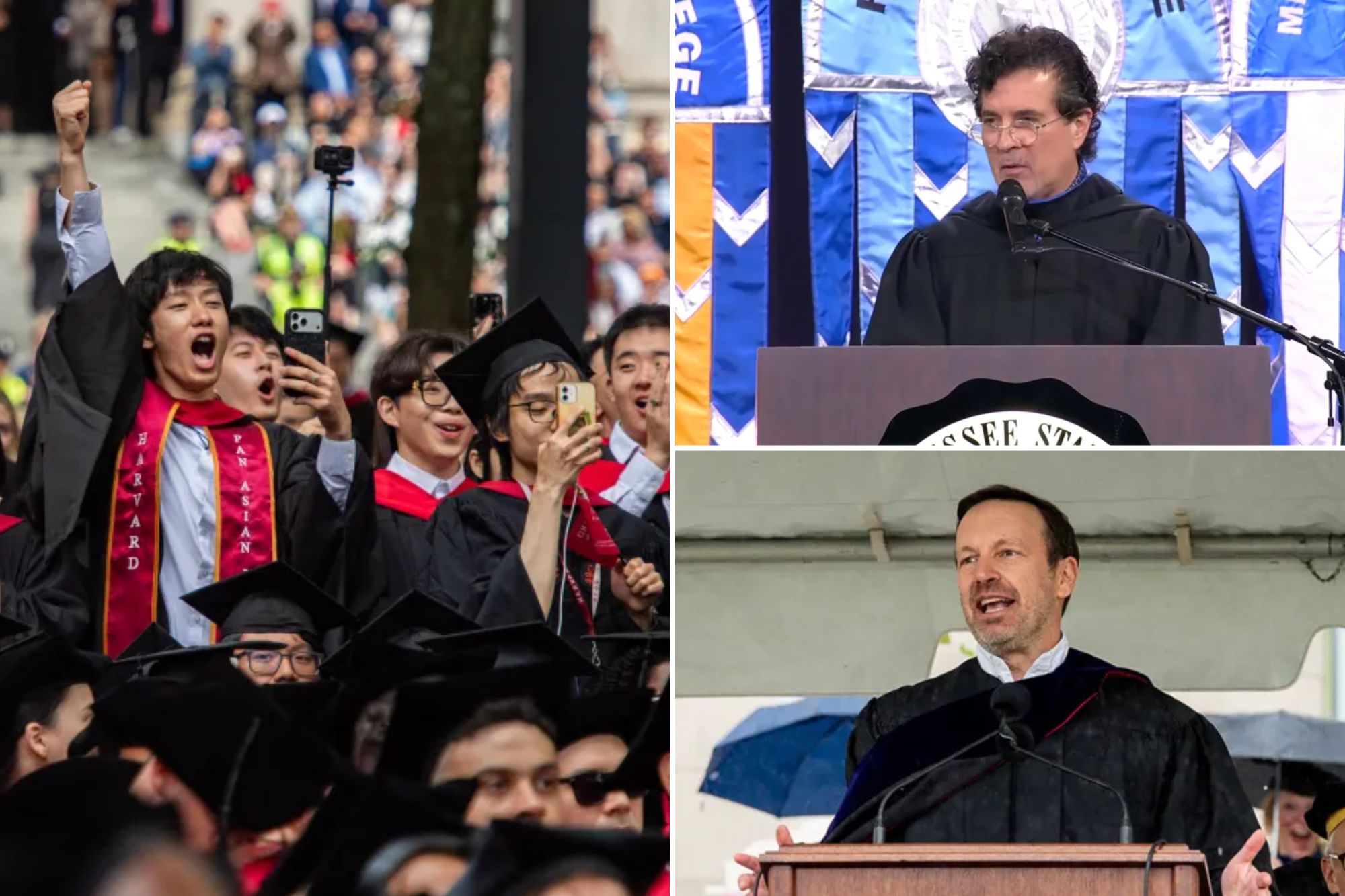
Former Google CEO Eric Schmidt and Big Machine Records CEO Scott Borchetta were booed at the University of Arizona and Middle Tennessee State University, respectively, for seemingly praising artificial intelligence.
Borchetta snapped at jeering students — who were warned for years not to use AI under any circumstances lest they be flunked — telling them to “deal with it.”
He apparently didn’t read the room. Gen Zers believe by a 3-to-1 margin that the technology will take more opportunities away than it creates; they are more anxious and less hopeful about AI every year.
Other grad speakers dunked on AI, eliciting cheers from students. But disparaging the technology isn’t helpful, either.
“A lot of other respected graduation speakers at colleges around America are talking about you guys needing to master AI for the future,” comedian Ronny Chieng told Harvard grads. “I’m here to tell you the mission of your generation is to destroy AI, kill it.”
But perhaps the most disturbing pattern to emerge from all these AI allusions is the striking similarity.
We’re told artificial technology is going to do the thinking for us and squelch human originality, making everyone’s output sound the same. In reality, fear of AI is already doing the job.
At Northeastern, students were said to be “graduating into the fastest period of change in human history.” And at Maryville College, they were “graduating into a complex world, a world shaped by technological change.”
At Yale School of Management, “You’re launching your professional careers just as the world is being remade.” And at Loyola Marymount, “You are graduating into a world transformed by AI.”
Not exactly original insight to inspire the next stage of life.
So far fear of AI is more flattening than the technology itself. All of the anxiety about an AI-fueled dystopia is actually creating one.
Gen Z can’t allow themselves to freeze in terror.