To play this video you need to enable JavaScript in your browser.This video can not be played
Scotland's Most Iconic Goals - Watch Archie Gemmell's v Netherlands
BBC Scotland's chief sports writerPublished8 hours agoArgentina '78 - the story of Scotland daring to dream and waking up in a nightmare never gets old. It's a footballing farce, a sporting tragicomedy.
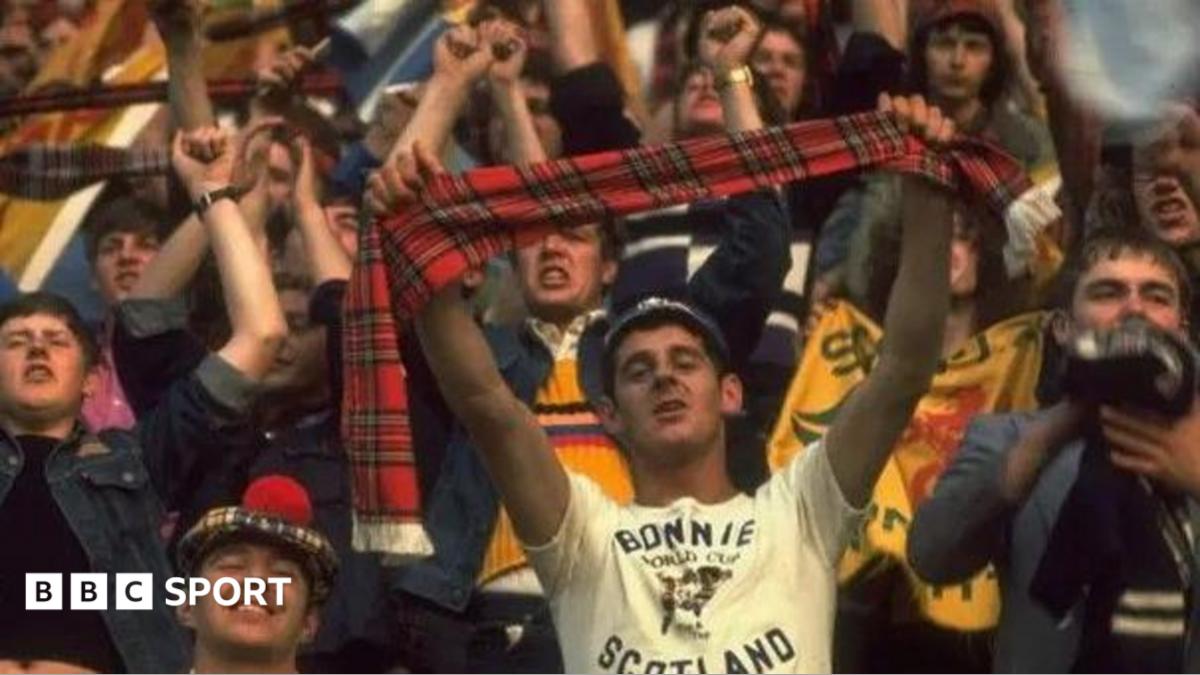
Some of the gold is provided by the Tartan Army and the extraordinary lengths some of them went to in order to be part of history. Not the kind of history they were getting, but history all the same.
How many books, or chapters of books, have been written about 1978? How many newspaper and magazine articles? How many documentaries? And yet there's still a buzz about a telling of what went on in Argentina.
Ally MacLeod's bravado was of Muhammad Ali proportions.
Had the manager been canny and well prepared then Lord knows what this excellent squad might have achieved and what impact on Scottish political history it might have had.
His confidence in his team led him to say that he'd cleared a place in his wardrobe for his World Cup winner's medal. He spoke at times about how the World Cup final date would come to be known as National Ally Day.
It was pantomime stuff and it was infectious. A bandwagon rolled. AC/DC played a gig wearing Scotland jerseys. Blue Peter presented the somewhat perplexed squad with a special good luck badge.
Scottish nationalism was on the march with the SNP making record gains. A pro-union newspaper in England wrote that Scotland winning the World Cup would be like "distilled firewater. Hooched up on that, the nationalists could rampage to victory".
In 1978, Scots roamed across the British football landscape like gods. In the August of 1977, Kenny Dalglish, whose famous goal against Wales helped secure the finals place, had become Britain's most expensive footballer when arriving at Liverpool. Five months later, Gordon McQueen would set a new transfer record when joining Manchester United.
Liverpool had just won the European Cup with Alan Hansen, Graeme Souness and Dalglish the spine of the team. Ipswich had just won the FA Cup with John Wark and George Burley. Nottingham Forest had won the First Division title and the League Cup with Kenny Burns, Archie Gemmill, John McGovern and John Robertson. Burns was the player of the year in England. A fine Rangers team had won the domestic treble.
To play this video you need to enable JavaScript in your browser.This video can not be played
Scotland's Most Iconic Goals: Kenny Dalglish's v Wales
And Scotland? In the qualifiers for the '78 World Cup they'd eliminated Czechoslovakia, the reigning champions of Europe.
By that summer, MacLeod's squad had in its ranks almost 60 individual medals, from champions of Scotland and England, to Scottish Cup and FA Cup winners, to European Cup, Uefa Cup and European Cup Winners' Cup winners. His group was loaded with quality.
The manager was perfectly entitled to think to himself that they might be good enough to win the World Cup. Saying it out loud again and again and again was where his problems started.
No research was done on the opposition. A television company offered MacLeod an all expenses paid trip to watch Peru before the tournament, but he turned it down. In qualifying, the Peruvians had topped their section ahead of Chile and had put five goals past Bolivia, who had already knocked out Uruguay, but Scotland's players knew none of this. Peru played Brazil and lost just 1-0.
Image source, SNSImage caption, Hector Chumpitaz (right) captained Peru to an opening group win over Scotland
Iran were a poor side but no work was done on how to expose them. That was the ultimate sin. MacLeod was in too much of a rush to get to the final to worry that much about how he intended to get there.
With a hugely disappointing one point from two games, a three-goal victory over the formidable Dutch was required.
When Archie Gemmill waltzed through to score his second of the game, it put Scotland 3-1 up with 22 minutes remaining in Mendoza. However, a thunderbolt from Johnny Rep soon burst the balloon.
More than 25,000 people turned up to send Scotland on their way as an open top bus trundled round Hampden and only about 100 were there as they slinked back into the country.
The players dispersed and carried on winning trophies by the bundle. The success they had with their clubs just reinforced the gigantic failure they experienced in Argentina.
There's a mesmeric quality to this story of '78, a legend of how a man and a country lost the run of itself. The team didn't endure, but the tale of the struggle will live forever.