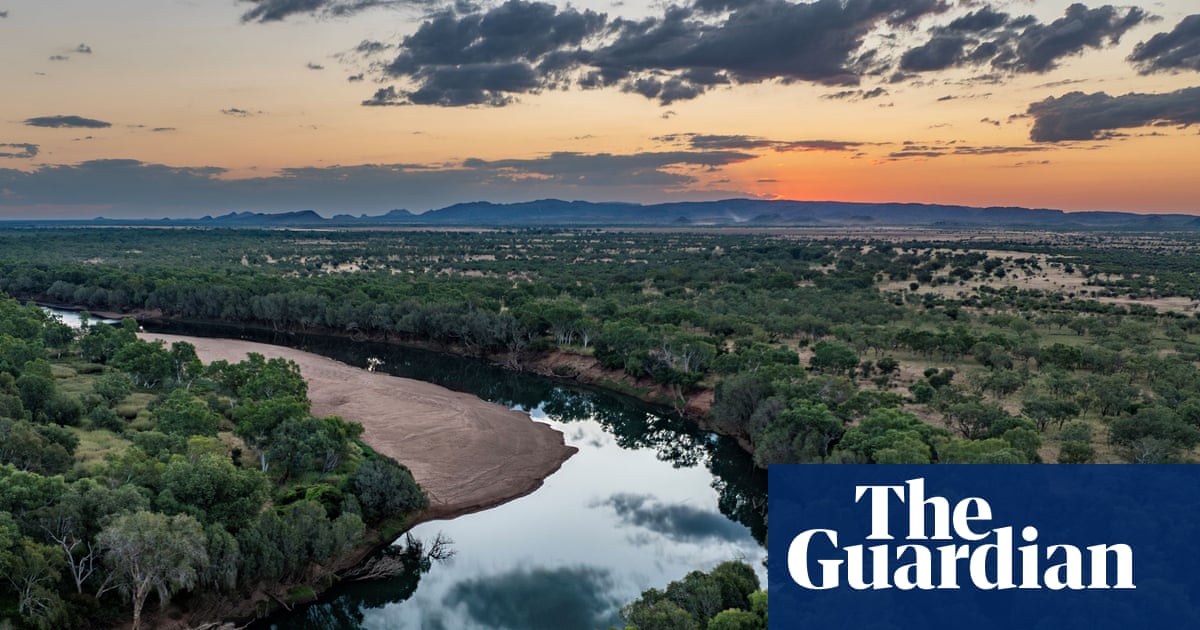
Black Mountain Energy is seeking federal approval to drill 20 gas wells for a project located near a creek that flows into the national heritage-listed Fitzroy River in WA. Photograph: Alex Westover/Environs KimberleyView image in fullscreenBlack Mountain Energy is seeking federal approval to drill 20 gas wells for a project located near a creek that flows into the national heritage-listed Fitzroy River in WA. Photograph: Alex Westover/Environs KimberleyDocuments reveal concerns over US company’s proposed gas fracking in WA’s Kimberley regionFederal environment department says Black Mountain Energy has provided insufficient data as it seeks to drill 20 gas wells in part of world’s largest tropical savanna
Get our breaking news email, free app or daily news podcast
The federal government has repeatedly raised concerns about an American company’s bid to frack for gas in Western Australia’s Kimberley region, part of the world’s largest and most intact tropical savanna.
Texas-based Black Mountain Energy, through its subsidiary Bennett Resources, is seeking federal approval to drill 20 gas wells for its Valhalla project west of Fitzroy Crossing.
Read moreThe site is located near a creek that flows into the national heritage-listed Fitzroy River, potentially opening WA’s Fitzroy valley landscape to fracking and affecting the region’s endangered species.
While WA’s Environmental Protection Authority has recommended approval of the development under state laws, documents released through freedom of information show the federal environment department has repeatedly raised concerns about the standard of the company’s environmental assessments.
The department warned the company it had not provided enough information about water resources and ecosystems that could be harmed by its gas drilling plans.
Correspondence shows federal officials told Black Mountain Energy on multiple occasions last year that it had not done enough work to identify the region’s surface water and groundwater resources and “characterise” ecosystems in the area that relied on groundwater for survival.
Officials wrote this prevented them from being able to fully assess the impacts fracking could have on the region’s environment and vulnerable species, including the critically endangered northern blue-tongued skink and the endangered largetooth sawfish, which has an important nursery area in the Fitzroy River.
The company was also instructed to consult with additional traditional owner groups with cultural and spiritual connections to the Fitzroy River.
The department wrote that despite Black Mountain arguing there would be no impact on the Fitzroy River, there was “insufficient evidence” that was the case. Officials said the company therefore needed to “demonstrate assessment of all impact pathways associated with the Rainbow Serpent Tradition Values”.
Conservation group Environs Kimberley, which applied for the documents, wrote to the federal environment minister, Murray Watt, last week to request he use his powers under national nature laws to terminate the project.
View image in fullscreenKimberley residents gather at Willare Bridge over the Martuwarra Fitzroy River to call on WA premier Roger Cook to ban fracking in the region. Photograph: Damian Kelly/Environs Kimberley“We’ve called on him to essentially scrap the assessment because the company has clearly not done what the department has requested in terms of providing information,” Environs Kimberley executive director Martin Pritchard said.
“They’ve had long enough to undertake this work. They appear to be not wanting to do it and without that work there’s no way the commonwealth could make a decision on whether there would be significant impacts or not.”
Environment officials said in a document in January this year that they shared concerns raised by an independent expert scientific committee that Black Mountain had not provided enough data to thoroughly assess the project. The IESC advises government on the potential impacts of gas projects on water resources under the federal water trigger.
The committee found Black Mountain had conducted a “limited and disjointed assessment” and reached “largely unsupported” conclusions regarding the project’s potential impacts to surface water and groundwater resources and related groundwater dependent ecosystems.
The department agreed there was “substantial uncertainty regarding hydrogeological and hydrological processes, surface water-groundwater interactions and presence of groundwater dependent ecosystems … which limits the ability to assess all potential impacts on water resources”.
Officials wrote that the lack of work by the developer to identify “site specific” groundwater dependent ecosystems, or investigate “surface water groundwater connectivity” in the area “does not allow the department to accurately assess the impact pathways associated with the northern blue-tongued skink and the largetooth sawfish”.
Guardian Australia asked the department and Black Mountain Energy whether the company has since provided the requested data and information.
Pritchard said the potential for the project to harm both species and the broader Martuwarra Fitzroy River and Kimberley region was concerning.
“This is the last place in the world that should be industrialised by the oil and gas fracking industry,” he said. “It has the largest, most intact tropical savanna in the world and it’s in the top 4% of the least impacted coastlines anywhere on the planet.
“There’s not many places like that left in the world.”
A department spokesperson said because the project was under active assessment, the government could not comment on specific details. But they said “any project being assessed under the national environment law must pass a rigorous assessment of potential impacts on protected matters, prior to approval”.
The project is being assessed for impacts on water resources, threatened species and the national heritage values of the West Kimberley. As part of the process, the developer would be required to publish its documentation for public comment and demonstrate how they have addressed the department’s feedback.