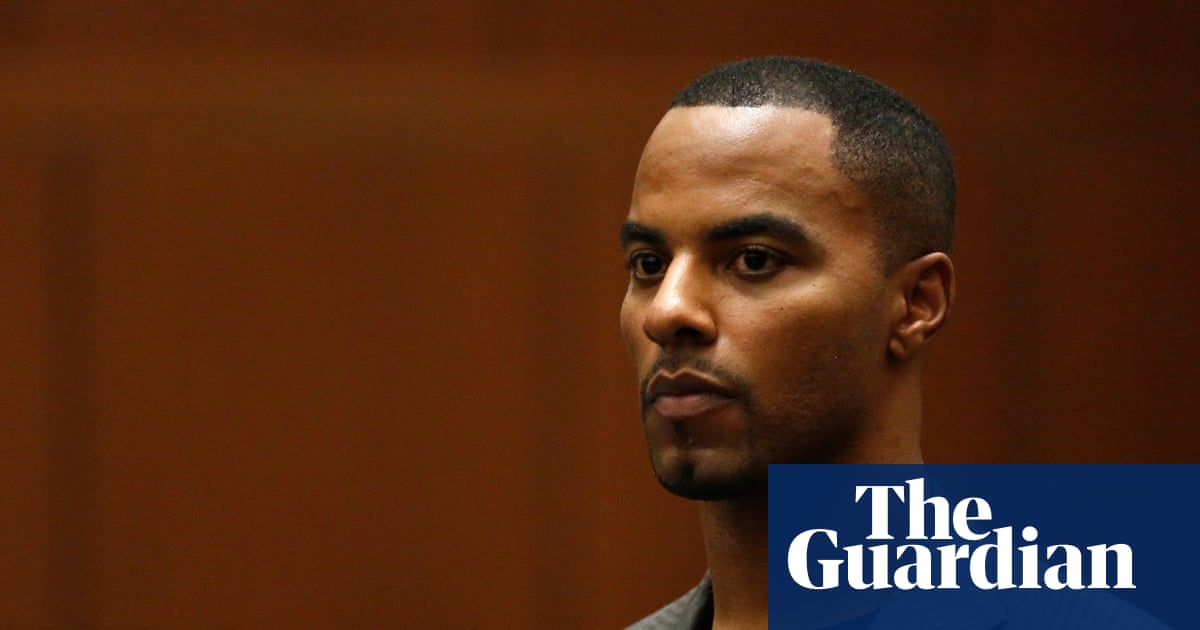
Former NFL player Darren Sharper appears for his arraignment at the Clara Shortridge Foltz criminal justice center in Los Angeles, California, on 20 February 2014. Photograph: Mario Anzuoni/ReutersView image in fullscreenFormer NFL player Darren Sharper appears for his arraignment at the Clara Shortridge Foltz criminal justice center in Los Angeles, California, on 20 February 2014. Photograph: Mario Anzuoni/ReutersSerial rapist ex-NFL player transferred from prison to halfway houseDarren Sharper, who pleaded guilty or no contest to raping women in four states, is projected to be released in 2028
Admitted serial rapist and former National Football League champion Darren Sharper has been transferred from federal prison to a halfway house program with his projected 2028 release date nearing.
In a statement to the Guardian on Monday, a US Bureau of Prisons (BoP) spokesperson said Sharper, 50, was transferred on 27 May from a federal correctional institution near Elkton, Ohio, to “community confinement” overseen by the agency’s residential re-entry management office in Baltimore.
The spokesperson said the transfer in Sharper’s case means he is either in home confinement or living at a residential re-entry center, a kind of facility colloquially known as a halfway house.
Details about exactly where Sharper was transferred were not immediately available. The BoP has previously said it does not disclose the specific locations of people in community confinement for privacy, safety and security reasons.
Sharper pleaded guilty or no contest in 2015 and 2016 in local courts in Louisiana, California, Nevada and Arizona to charges that he had drugged and raped – or tried to rape – numerous women in the four states. He also pleaded guilty in New Orleans’s federal courthouse to plotting to carry out the drugging and rape conspiracy.
The case at one time commanded significant attention from the national and sports media because Sharper had won a Super Bowl championship with the New Orleans Saints in February 2010. The defensive superstar from Richmond, Virginia, also led the NFL in pass interceptions in two of his 14 years in the league before retiring in 2011. He earned prestigious first-team, All-Pro selections in each of those seasons.
After his series of guilty pleas, federal judge Jane Triche Milazzo sentenced Sharper to 18 years in prison in August 2016, giving him credit for the time he had served in authorities’ custody since his initial arrest in the case in February 2014.
Sharper at his sentencing said he apologized “a thousand times” for his acknowledged actions – while one of his victims bluntly told him to “go to hell”.
Many people sentenced to federal prison can become eligible for release after serving about 85% of their punishments – and they can effectively lower that percentage by completing certain programs while incarcerated, according to government officials.
Being sent to a halfway house program is a clear indication of nearing the completion of a sentence.
Those at halfway houses generally are required to find a job and may be allowed to drive or use a cellphone for employment purposes. Beside being moved to confinement in a private residence, they can also get recreational passes.
Two codefendants of Sharper who also pleaded guilty were Erik Nunez – once a steakhouse waiter – and Brandon Licciardi, a former deputy of a suburban New Orleans sheriff’s office.
Nunez finished his sentence in July 2023. Licciardi did the same in April.
Sharper’s projected release date on Monday was listed as 27 December 2028.
Prior to his halfway house transfer, Sharper’s attorneys had argued to Milazzo that he deserved consideration for an earlier release from his sentence after taking a number of educational classes during his imprisonment and generally proving himself to be “a model inmate”.
Among other things, they also maintained that a release from prison would allow Sharper “to finally receive treatment for … traumatic brain injuries … and probable chronic traumatic encephalopathy … disease developed from his years playing football”.
The disease mentioned by Sharper’s attorneys – which has similarities to Alzheimer’s – has been linked to repetitive blows to the head and concussions for athletes such as football players.
Milazzo in August turned down Sharper’s request for a reduction in his sentence, court filings show.