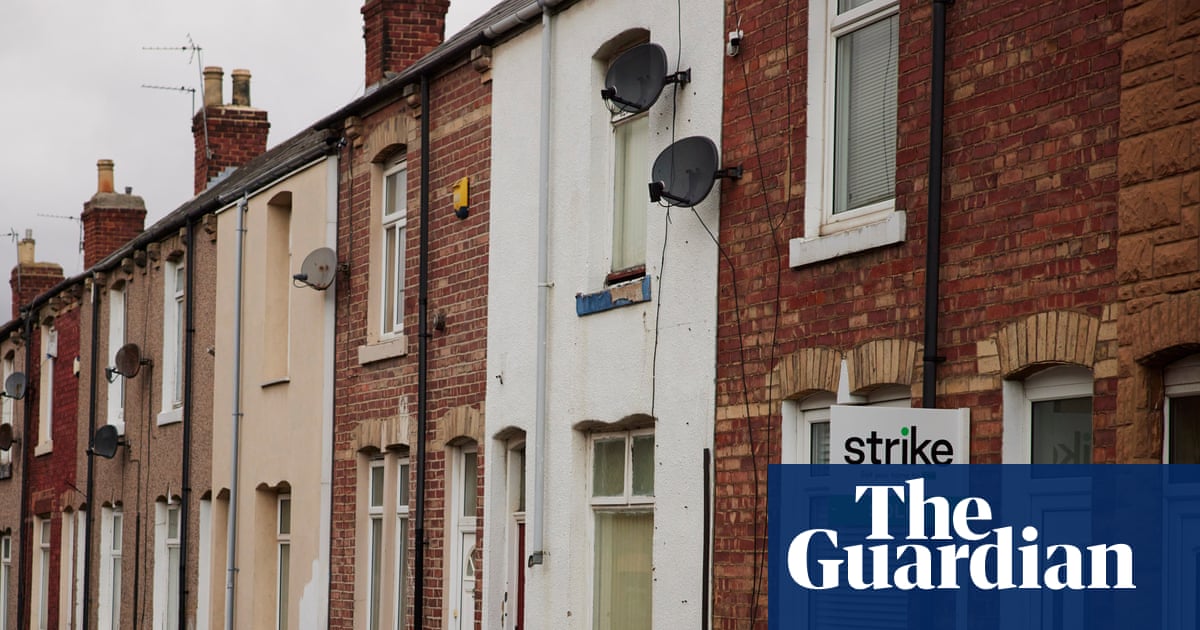
Houses in Hartlepool. Some London families have been sent to the town, whose MP said the policy was increasing local tension. Photograph: Christopher Thomond/The GuardianView image in fullscreenHouses in Hartlepool. Some London families have been sent to the town, whose MP said the policy was increasing local tension. Photograph: Christopher Thomond/The GuardianMinisters could ban London councils ‘dumping’ homeless families miles awayMeasures being considered to crack down on practice that has grown as a result of Britain’s housing crisis
London councils could be banned from “dumping” homeless families hundreds of miles across England under measures being considered by ministers, the Guardian has learned.
MPs said vulnerable people, including women fleeing abuse, were being “coerced” into choosing between rough sleeping or moving to cheap, sparsely furnished properties in some of the poorest parts of the country.
Charities said the policy meant some domestic abuse victims had returned to their abuser because they did not want to move north, while others were having to live in emergency domestic abuse refuges.
Ministers are planning to crack down on London councils increasingly sending homeless families far away from the capital, a practice that has grown as a result of Britain’s housing crisis.
Some London councils, which are at the forefront of the increase in homelessness, have been found to have acted unlawfully in dispatching vulnerable families to cheaper housing hundreds of miles away.
After a Guardian investigation published on Monday, Florence Eshalomi, the chair of the Commons housing select committee, urged ministers to “seriously examine introducing a limit on the distance of all out-of-area placements”.
Alison McGovern, the homelessness minister, said the practice was a “real worry” and that the government was prepared to “clamp down on the worst form of it” after a review currently under way.
Government guidance states that out-of-area placements should “never be determined on the basis of cost alone” but McGovern said ministers would consider going further, because “something is clearly not working here”.
Any ban on long-distance moves is likely to include exceptions for people who need to leave London.
Jonathan Brash, the Labour MP for Hartlepool in County Durham, called for the law to be “radically tightened” to stop a policy he said was increasing local tension and “ripping at the social fabric” of his town. He said: “It is not fair, it is not sustainable, and it is time it stopped.”
Under the Housing Act, local authorities must “so far as reasonably practical” find accommodation in their borough. If it is outside this area, the council must legally notify the other local authority that they are sending homeless people to them.
However, several London councils have been found by the high court to have acted unlawfully in recent years. Housing lawyers, charities, MPs and council leaders said some were routinely flouting the law.
View image in fullscreenEnfield Civic Centre. Enfield is one of the councils that has used Reloc8, a company that specialises in moving homeless families out of the capital. Photograph: Greg Balfour Evans/AlamySome London councils pay millions of pounds to intermediary companies to provide often unfurnished flats or houses more than 200 miles from the capital.
Last year, the Guardian reported that about a dozen local authorities had spent more than £140m buying properties to house homeless people outside the capital, including as far away as Liverpool and Coventry.
A Derbyshire-based firm called Reloc8, which specialises in moving homeless families out of the capital, has been paid about £2m by two local authorities, Croydon and Enfield, to facilitate these moves.
Sophie Earnshaw, a strategic litigation solicitor at the housing charity Shelter, said companies such as Reloc8 offered councils a “quick fix” but were benefiting financially from the housing crisis.
She added: “We cannot allow private companies to cash in on the housing emergency, and councils’ desperation to house people, if it means struggling families are left paying the price.”
In a statement responding to the Guardian’s initial reporting, Reloc8 said that it had “many success stories over the years” involving those who had been moved.
The total number of homeless families dispatched across England is not known, as several London councils do not keep a central tally. However, official figures show that the number moved out of London has doubled in the past two years – up from 670 in the year to March 2023 to 1,300 in the year to March 2025. The true figure is believed to be higher.
London Councils, which represents the capital’s 32 boroughs, said most out-of-London placements were to counties bordering the capital and that it had met local authorities in north-east England to discuss the issue.
The Guardian has been told of one domestic abuse victim who was placed in a property 200 miles from London, where she was surrounded by drunk and aggressive men. The woman was so fearful of those living nearby that she eventually ran away.
Bo Bottomley, of the domestic abuse charity Refuge, said: “The increase in unsuitable housing offers means survivors have no choice but to stay in refuges for longer, creating a cycle in which other survivors are unable to access emergency refuge accommodation due to the shortage of spaces.”
Charities said councils often did not consider the homeless person’s cultural and religious needs. One Muslim woman, a migrant, was sent by a London council to a predominantly white village in the north-east of England, only to find the nearest mosque was one-and-a-half hours away by bus.