Add The New York Post on Google A 23-year-old Long Island student knows he should not be alive — and up till last week, he had one person to still thank for saving him.
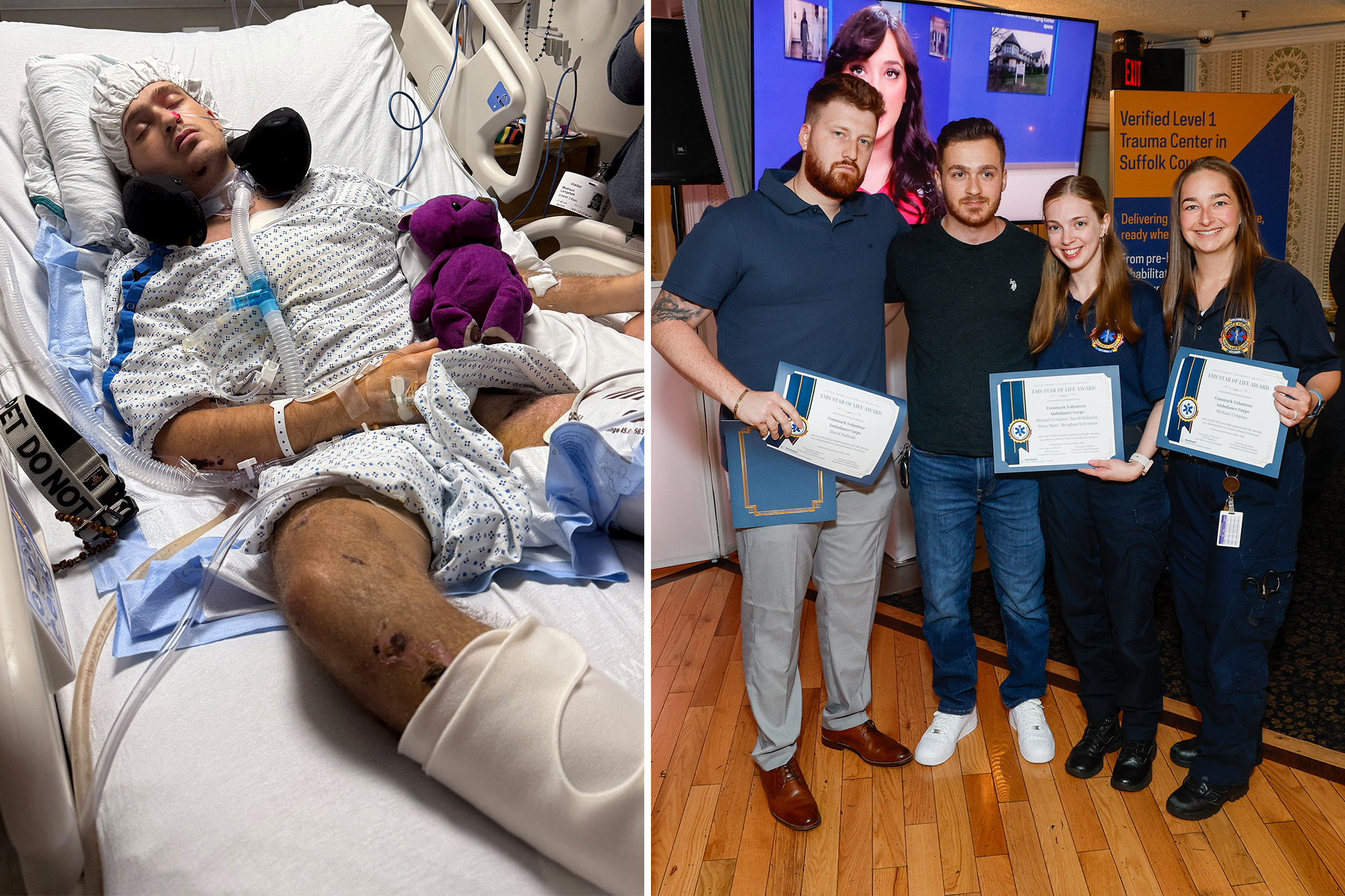
Christopher Barradas was riding his Ducati motorcycle when he smashed into a pickup truck in September, leaving him dying as he bled out near the Sunken Meadow Parkway.
Commack EMT Michael Crispino, also an NYPD cop, ended up first at the scene to treat the Farmingdale State College economics student.
And while Barradas has met and thanked other medical staffers who later worked to keep him alive, it wasn’t until Thursday that he finally came face to face again with Crispino.
“It just goes to show how much EMTs do for everyone, even if you don’t necessarily realize it yourself,” said Barradas of Kings Park, recalling his experience while at a touching “EMS Heroes Night” held by South Shore University Hospital in Bay Shore.
Crispino, thrilled to be at the emotional event along with Barradas, said, “I see crazy stuff, but I never get to actually meet anybody I’ve saved.’’
Northwell trauma surgeon Dr. Matthew Bank told The Post how Barradas “was just spilling blood out onto the floor’’ when he was rushed to the ER that night.
“We actually need suction devices on the floor. He lost about 10 liters,” Bank said.
It took a heroic team of close to 50 doctors and medical workers to pull Barradas from death’s seemingly inevitable grip.
The group was ready to pronounce him dead multiple times because of the relentless internal bleeding from his chest.
“His heart stopped a few times that night,” said cardiothoracic surgeon Dr. Brian Fallon.
Fallon had to keep the organ pumping with his bare hands while it was exposed from Barradas’s open chest.
“That’s as dead as someone could be and really just somehow survive it. It was really not like nothing I’ve ever seen. I’ve been doing this 15 plus years now,’’ the top doc said.
The dedicated workers at South Shore eventually performed a gruesome “clam shell” incision by literally opening up Barradas entire chest from lungs to heart, which had to be resealed and reopened more than once.
Even some nurses looked like deer in headlights at the gory scene while effectively doing their jobs, Fallon said.
Doctors ended up performing impromptu additional surgeries at Barradas’s ICU bed because it was too dangerous at the time to move the young man to an operating room.
“When I woke up, it was kind of like it was an ‘oh crap’ moment,” said Barradas, an economics student at Farmingdale State College.
“I don’t have any memory of any of it actually occurring.”
As if living wasn’t enough of a miracle, Barradas is doing fantastic in his recovery and is already back at school only months later.
“I had to learn how to walk again and go upstairs again. … I had no clue how to do it anymore,” he said.
“Now at this point, it’s something I don’t think twice about.”
Barradas had been overwhelmingly grateful to the team of operators and staff who saved his life and has been a regular back at South Shore and its trauma unit for much happier reasons these days.
The one person he never got to show “all my thanks and gratitude” to was Crispino.
“It’s very rewarding,’’ Crispino said of reuniting with Barradas.
Barradas was shocked to learn that other EMS workers saved stroke victim Tara Krieger, who was also honored that evening, just hours before his near-death experience.
Krieger, a 54-year-old gym owner from Bayport, was unaware she was having a medical episode until someone called 911 and sharp-thinking EMTs acted fast on the scene at South Shore Fitness.
“They said, ‘Listen, this is urgent,’ ” recalled Krieger, who is dealing with only minimal residual effects and still crushing her workouts.
Thanks goodness they did, said Dr. Boris Chulpayev, who was Krueger’s caretaker at South Shore.
“Every single minute the brain doesn’t get blood supply, 2 million neurons die, so 5 minutes — that’s 10 million neurons, that’s significant disability,” he said.
“She was facing complete left-sided paralysis, most likely bed-bound for the rest of her life.”
Right after being released, she went to the Community Ambulance Company station house in nearby Sayville to thank the three men who responded to her call: Kenneth Newman, Austin Shimer, and Brian Noack.
“I told a couple people that I went there, and they were all like, ‘What do you mean?’ she recalled.“I said, ‘Why would you not thank the person that pretty much saved your life?’ ”