Add The New York Post on Google Scroll through any social media platform long enough and you’ll notice something that doesn’t quite add up. The same talking points, phrasing, and sudden outrage cycles are appearing across completely different audiences at the same time. It feels coordinated. And that’s because it often is.
Foreign adversaries have turned modern technology into a new kind of warfare, one the United States hasn’t fully named, hasn’t clearly assigned ownership of, and isn’t yet equipped to fight at the speed it’s being waged.
This is something more insidious than traditional espionage: the deliberate, systematic manipulation of how millions of Americans perceive reality—their leaders, their institutions, each other. China calls it the “cognitive domain,” a formal military concept treating perception itself as a battlefield alongside land, sea, air, cyber, and space.
Russia, meanwhile, just hiked funding for state media by 54% for 2026, even as it cut overall military spending. That money doesn’t stay on Russian screens. It bankrolls RT, Sputnik, and a sprawling network of proxies, bots, autonomous AI agents, and synthetic media engineered to reach Americans through social media and narrative laundering, at near-zero cost.
Beginning in 2022, Russia’s Doppelganger operation went so far as to clone the websites of Fox News and the Washington Post, registering near-identical domains and filling them with Kremlin-approved content. The DOJ seized 32 of those domains in 2024, and within 24 hours, new ones had already replaced them.
The weapons in question aren’t guns or missiles. They’re narratives, delivered at machine speed, engineered to deepen distrust and fracture the shared perception of reality that a functioning democracy depends on. And the target isn’t just one side of the aisle. Russia ran simultaneous Black Lives Matter and Blue Lives Matter pages during the 2016 election.
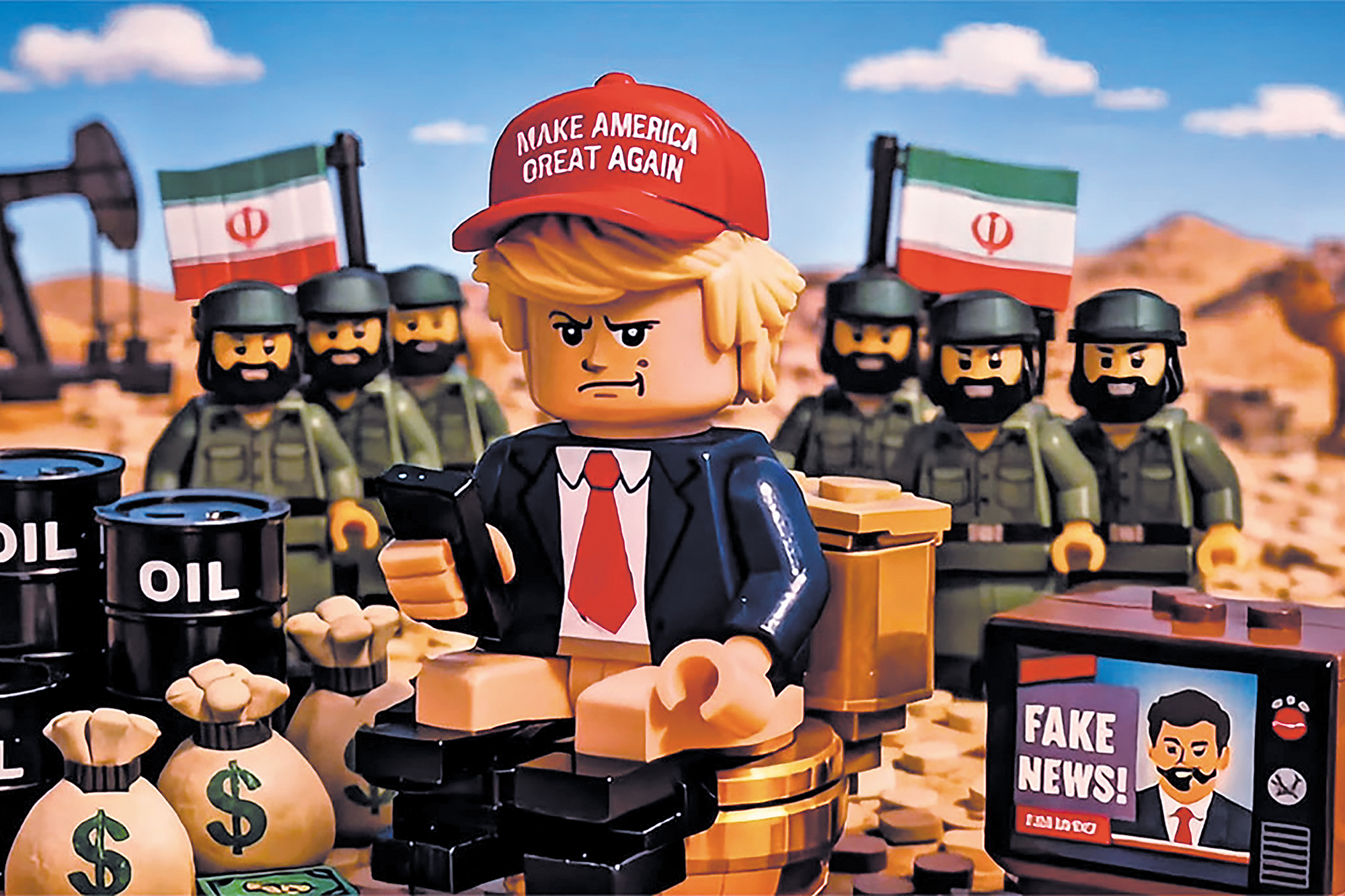
Earlier this spring, Iran joined the action. AI-generated Lego-style videos mocking President Trump, Pete Hegseth, and American military power flooded TikTok, X, and Instagram, racking up millions of views before platforms began pulling them. The firm behind the videos acknowledged to the BBC that the Iranian government was a client. Around the same time, Alexis Wilkins, girlfriend of FBI Director Kash Patel, alleged in a detailed X thread that a foreign-linked network, including Russia Today accounts, had spent 22 months coordinating attacks against her and Trump administration policies on Iran. The episode prompted X to announce changes to its monetization rules to curb foreign bot farms from boosting divisive American content.
A recent iProov survey found that nearly half of Americans now question the authenticity of almost everything they encounter online. Researchers call it the “liar’s dividend”: When people can no longer tell real from fake, bad actors benefit from the confusion itself, real evidence gets dismissed alongside fabricated content, and civic life quietly corrodes.
It also hands bad actors a ready-made shield. Once audiences are primed to doubt everything, even legitimate reporting can be waved away as a deepfake.
What makes this moment different from Cold War-era propaganda isn’t the intent, but the scale, speed, and deniability that modern technology provides. Soviet “active measures” were slow, expensive, and required human operatives. Today, state-backed outlets like RT are developing AI tools such as Meliorator, exposed by the FBI in 2024, designed to generate unique social media personas en masse, post content, and coordinate with other disinformation accounts automatically.
A single operation can now seed narratives across thousands of accounts simultaneously, amplified by real users who have no idea they’re participating. The manipulation launders itself through proxies and homegrown-looking groups until it’s nearly untraceable.
The United States is just starting to take this threat seriously, and it may be behind already. In March, the Pentagon’s Strategic Capabilities Office launched a new project to build basic cognitive defense capabilities, a multi-year effort that officials themselves stopped short of calling a strategy. Yet, the Pentagon’s own chief technology officer has openly admitted the U.S. cannot yet counter these operations at machine speed.
Meanwhile, China is already operating inside the gates. A network tied to American-born tech magnate Roy Singham, now based in Shanghai, has funneled roughly $100 million into U.S. nonprofits and activist organizations that echo CCP talking points under the cover of homegrown American advocacy.
The goal of all this isn’t necessarily to make Americans believe any single false story. It’s to manufacture enough chaos and doubt that we stop trusting our own judgment about the news, institutions, and each other.
The tools to fight back exist: stronger enforcement of the Foreign Agents Registration Act, investment in digital watermarks that verify content origins, and open-source detection technology. And where national security is clearly at stake, we should demand divestiture, forcing foreign-controlled platforms to sell to American investors, exactly as we did with TikTok. But none of it happens without urgency, and a single multi-year project is not a strategy. The first step is deceptively simple: name the war. The next is to fight it like we intend to win.
Iulia Lupse is the founder of I&A Communications Solutions and a senior contributor with Young Voices.